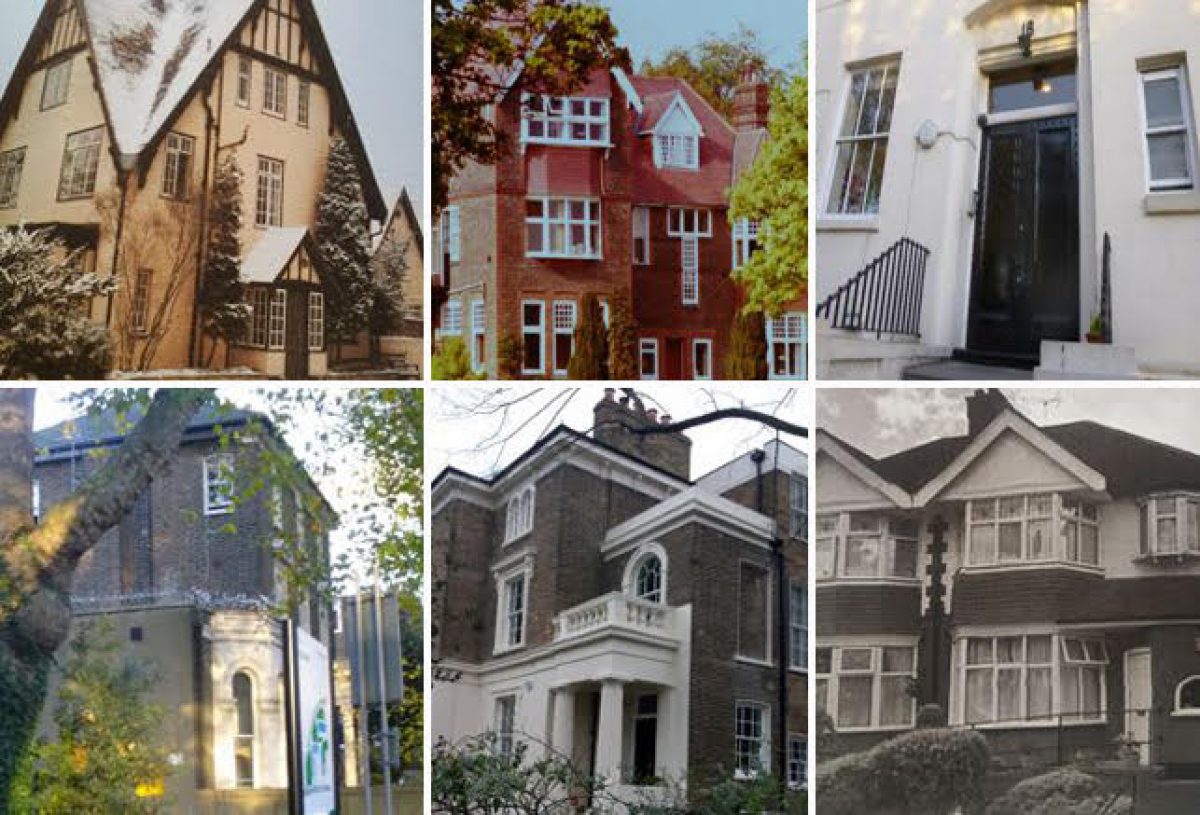
Address: 11-12 Highbury Crescent, London N5
Letterhead 1996
Open: 1971 – 1998


Number of ISN survivors that lived at Highbury Crescent children’s home.
67 : 34 women and 33 men
1970s:12 boys 10 girls
1980s: 20 boys 22 girls
1990s: 1 boy 2 girls
Numbers of children living at Highbury Crescent children’s home named by ISN survivors as living in this home: 142: 76 girls and 66 boys
1970s: 33 boys 31 girls
1980s: 31 boys 43 girls
1990s: 2 boys 2 girls
Numbers of children stated in documents as living in Highbury Crescent children’s home:
1971 council document stated Highbury Crescent was designed for 34 places. 24 for residential places and 10 for emergency day/overnight provision.
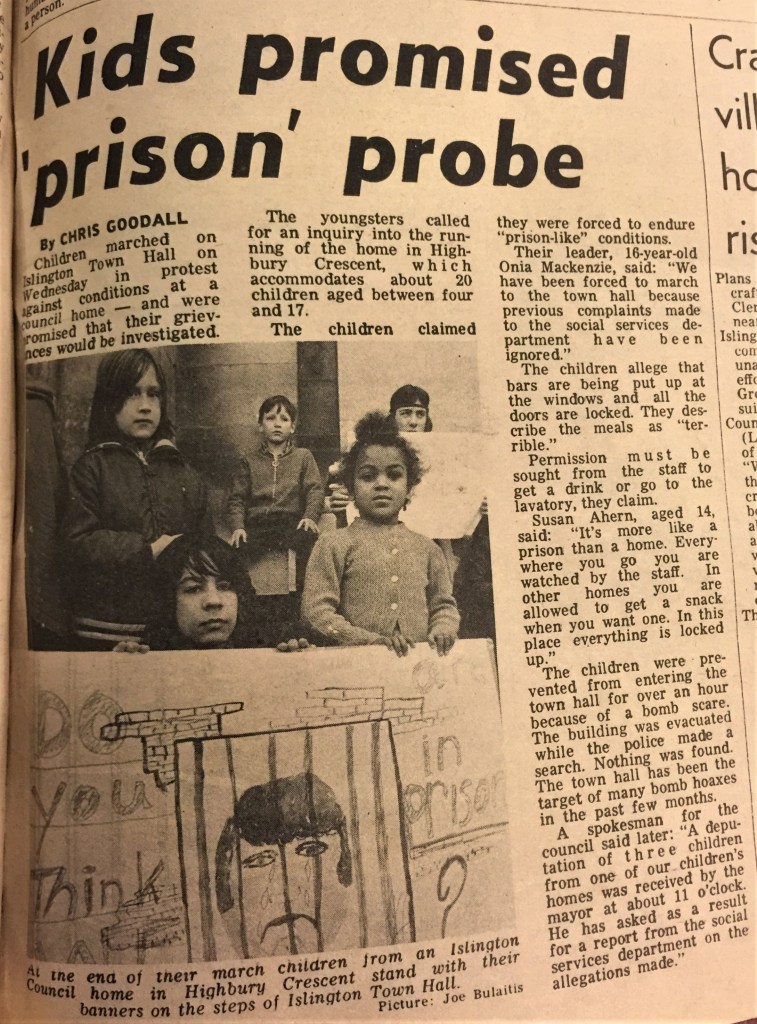
1972 press report (Islington Gazette 24.3.72) states home is for 20 children age 4-17 years.
1974 advertisement Highbury Crescent is a short stay children’s home for 29 children with accommodation for the Superintendent of a 3 bedroomed flat. Both single and married couple considered – in the latter both parties can be employed.
In 1974 the acting superintendent wrote on a survivor’s file that ‘we have had a number of girls staying here with their babies’. This home was not registered for the care of babies and staff would not have had the expertise required to assist the young mothers in the care of the babies.

In 1983 one of the staff wrote on a file that Highbury Crescent was divided into 11 and 12. 11 was for emergency admission and assessment for a period of 28 days. 12 was a short stay and assessment unit with planned admission and children stayed approximately 3 months whilst family work was undertaken to return them home or while an appropriate residential placement was looked for.
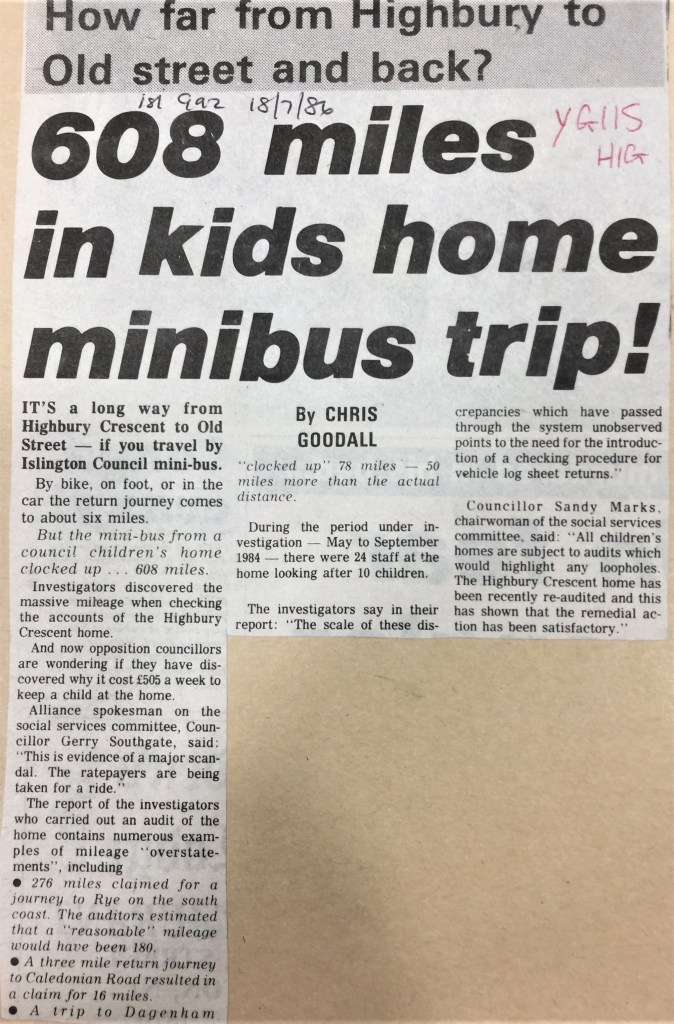
1986 press report states May-Sept 9184 there were 24 staff and 10 residents (Islington Gazette 18.7.86)
1988 press report (Islington Gazette 8.12.88) states Highbury Crescent as have 14 places for short term care of children.
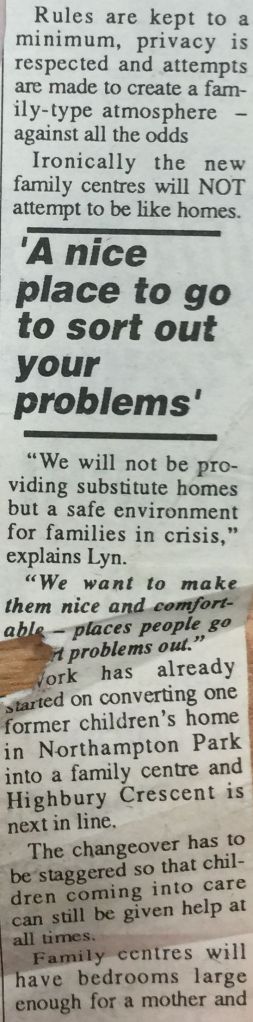
31.5.90 (Islington Gazette) states that the building is now a new style Family Centre for 14 children not as it was for 40 children as a children’s home.
Residential staff named by ISN survivors as working in Highbury Crescent children’s home: 56 men and 53 women
Life at Highbury Crescent children’s home
The LOCK-UP Basement room at 11 Highbury Crescent
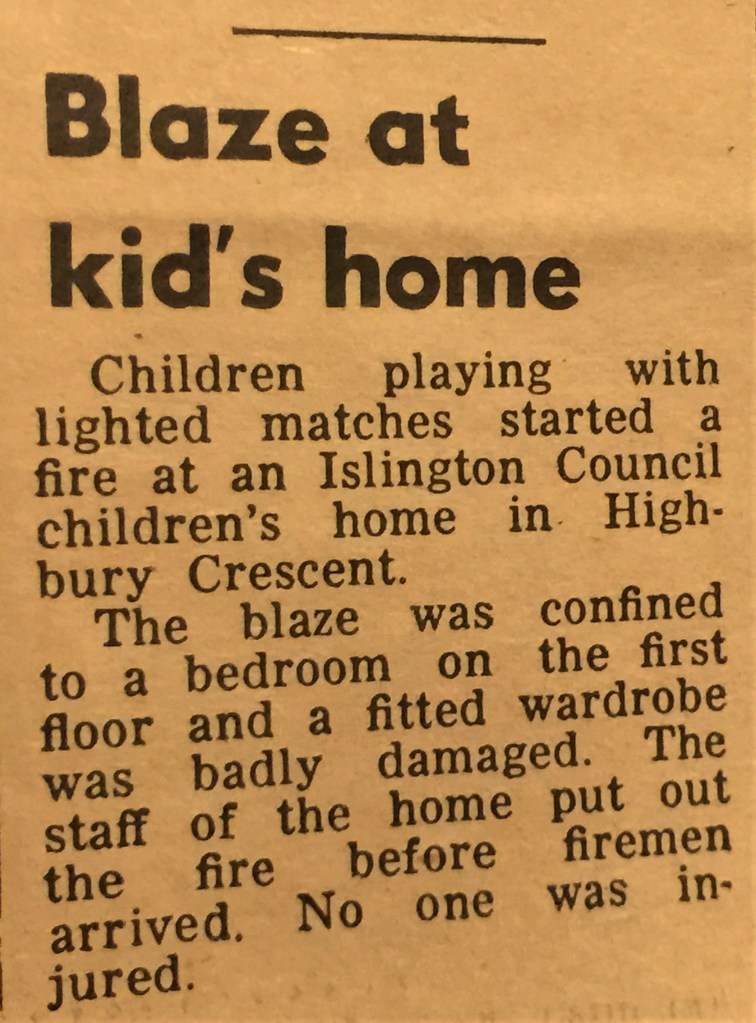
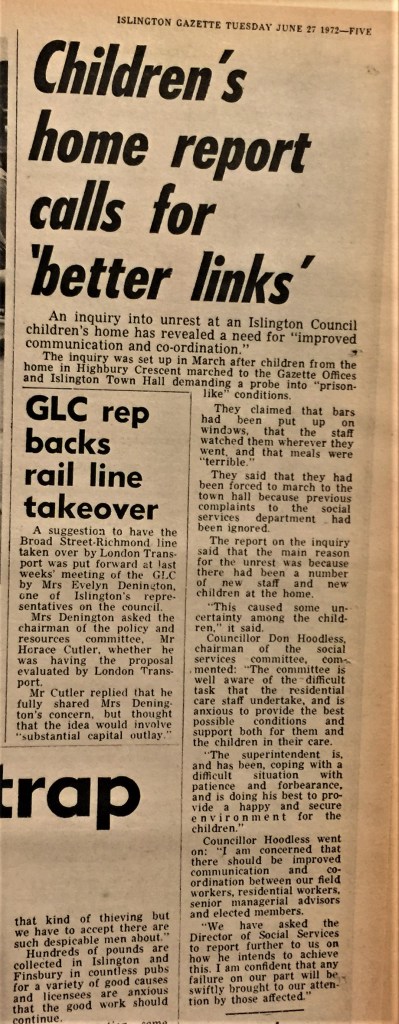
In 1972 over 50 children marched to the Town Hall to complain about conditions in the children’s homes. (See below: Islington Gazette 24.3.72 ‘Kids promised prison probe’ and 26.7.72). ‘The children allege that bars are being put up on the windows and the doors are locked’. In 2024, Islington Survivors Network is still striving to draw attention to the crime by Islington staff of ‘false imprisonment’. The homes had no legal powers to lock up children. These were children’s homes not secure units or youth detention centres. This recruitment advertisement disgracefully describes the children as ‘disruptive, violent and aggressive‘. This is so wrong. It was a home for traumatised children who needed care for many reasons – often because their parents just could no longer look after them.

15 survivors have spoken about being locked up in a basement room near the kitchen in 11 Highbury Crescent. This was devastating for the girls and boys – some as young as 8 years old. This could be for an hour or many hours and even for 3 days and nights. It was a room described as a ‘padded cell’ which was all white and had nothing at all in it. It was locked from the outside and the children had to shout to get someone to take them to the toilet. One said the only thing to do was sleep as there was nothing to do. It was ‘terrifying’ said one survivor. Some describe it as having iron bars and that it had been a storage room or ‘ larder’. This was of course ‘false imprisonment’ which is a crime. No-one has been brought to justice for this crime. No-one has been to visit the premises and see this room for themselves.
‘I was locked up for hours at a time and I would just curl up and sleep as there was nothing to do’.
‘If you were unlucky you would be put in the cupboard downstairs – this happened to me 3 times. They would grab you and push you in there. I remember I caught my fingers in the door – it was a double door. I would be there on my own for 2-3 yours. It was locked form the outside. There was nothing in the room. It was like a storage room by the kitchen’.
‘Highbury Crescent had a larder a lower tier room with solid iron bars – a lock up. I knew children who were locked up there’.
‘A member of staff locked me in a downstairs room several times. This was terrifying. I was emotionally distraught. I had no-one to go to to tell about this situation’.
We were abused by staff and by strangers
12 survivors, men and women, have described Highbury Crescent in the 80s. Strangers gained access to the home coming in through an open front door or via the balconies. Some children were sexually abused by other residents and others by staff but there are accounts of the children abused at night not knowing who the abuser was. The following quotes are from survivors
‘The home was open to anyone to do what they wanted. Someone sexually abused me and came in my bedroom. There were always strangers going in and out ‘.
‘I was sexually abused by one of the staff. It was not a safe place to be’.
‘There was sexual abuse of girls by staff at night – this happened to a girl I shared a room with‘.
‘The girls rooms were next to the boys rooms with balconies that could be climbed over’.
‘There was sexual abuse by staff’.
‘I was threatened by 2 male staff and felt shock and fear’.
‘Sexual abuse happened by staff to my friend’.
‘I was sexually abused in a room in the house’.
‘There was serious abuse at Highbury Crescent’.
‘I was sexually abused in my bedroom many times day and night’.
‘In this home I was exposed to sexual exploitation. There was no protection’.
‘There was no supervision in this home’.
From the 70s to the 90s there are similar accounts by survivors of sexual abuse by staff and strangers in Highbury Crescent – sometimes in the children’s bedrooms and sometimes when they were taken elsewhere. Islington Survivors Network have heard from over 30 survivors (men and women) who were resident in 11-12 Highbury Crescent during those years.
This led some to take risks by escaping over the balconies which was very dangerous and some fell from a height. They would then sleep in Highbury Fields park over the road or in abandoned cars and garages nearby. The survivors consistently report that staff made no attempt to stop what was happening.
‘The culture was that the boys would come in my room’.
‘Boys climbed over the balconies to come in our rooms’.
‘We pushed a chair behind the door so no-one could get in’.
‘I was in fear all the time about people coming into our room’.
‘At night staff would come in our room and hit us. We ran away because of this’.
‘Kids were taken to abuse parties from Highbury Crescent’.
‘The sexual exploitation was very severe’.
‘There were drugs and sexual activities all the time in this home’.
‘ There was a lack of care and we were left to wander the streets’.
‘I was sexually abused by male staff’.
‘Men went into girls rooms and sexually exploited them’.
‘I was sexually harassed by a member of staff so I slept in the park to avoid him’.
‘Visitors would come in men and women and we had no idea who they were. One of them took us to the forest’.
‘It was a mad house day and night’.
‘This home was a free for all. there was no structure and loads of strangers came in and out all the time.’
‘Boys hung around outside the children’s home and got in’
‘One night I woke up to find someone on top of me. It was dark’.
‘The door was always open and anyone up to trouble would run in’.
‘At night men would loiter around and I hid’.
’I slept in a car for a week’.
‘The staff let in whoever they liked’.
‘Men would come into the home and the staff wouldn’t stop them’.
Roger Moody (see this link to Report 10 on this website for more information about Moody and his pro-paedophile writings)
Someone in the children’s home should have noticed but no one was interested in us’. ISN Survivor of abuse by Moody
Moody was a youth worker in Islington Council, a self professed paedophile he groomed boys from Highbury Crescent. He died in 2022. ISN had been reporting concerns about him to the Islington LADO for some years because he wrote openly about his beliefs about paedophilia. In 1980 he wrote a book ‘Indecent Assault’ which states it was a ‘defence of paedophilia’ and ISN’s concern was that he was still active in the voluntary sector. The council officer said that he had no contact with children in his work at the Community Centre in Seven Sisters Road, Islington and therefore there were no concerns.
In 2020, more evidence came to light when some survivors came forward to ISN and disclosed abuse by Moody who got to know children at the adventure playground and had access to children at Highbury Crescent children’s home in the 80s. He died in 2022.
North London: Youth worker Roger Moody was a proud paedophile
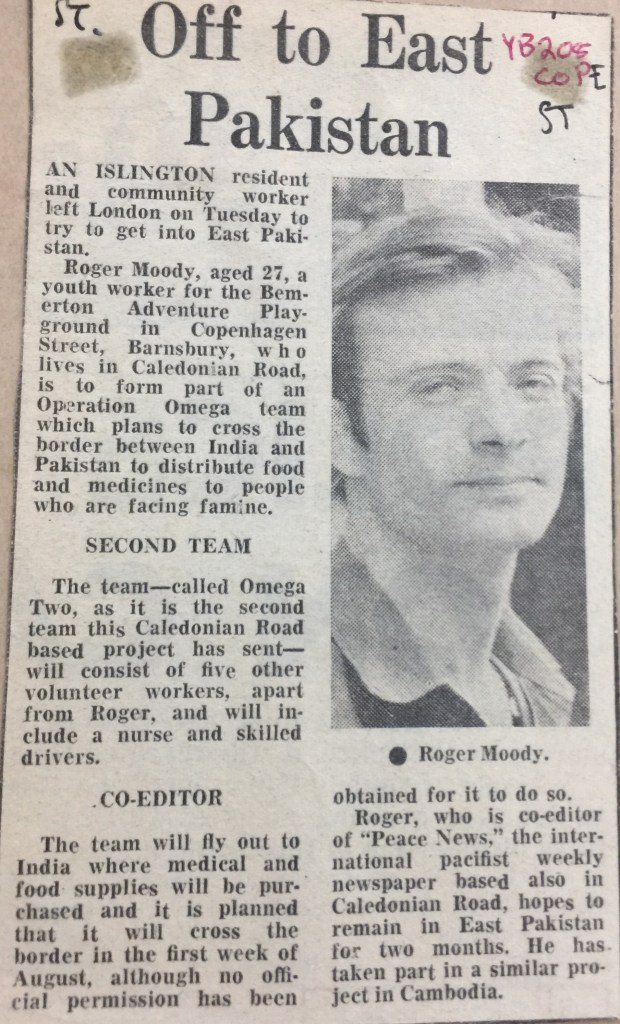
Article on Moody from 1972 (from Islington Library) describing him as a youth worker in Bemerton Rd Adventure Playground.
Islington Gazette 28th March 2023
By Charles Thomson Investigations Reporter
A proud paedophile managed to continue working with children even after authoring books, articles and pamphlets advocating sex between men and children.
Throughout the 1970s and 1980s, youth worker Roger Moody called for the age of consent to be abolished, even writing a book bemoaning “simplistic and bigoted” attitudes towards paedophiles.
But press cuttings from the late 1980s and early 1990s show he was still managing to get jobs working with children.
Earlier this month, the Islington Gazette interviewed a Met Police officer who said he was abused by Moody in the 1990s and recalled him being a volunteer at an Islington adventure playground.
In 2020, that officer was one of two people to approach the Islington Survivors Network (ISN) and report historic abuse by Moody.
Others made allegations decades earlier, but Moody was acquitted at trial.
Moody died in 2022.
The Gazette interviewed a Met Police officer who said he encountered Roger Moody as a direct result of neglect at the former Highbury Crescent children’s home.
‘Boy lover’
Roger Moody was a left-wing activist, campaigning against human rights abuses in the developing world.
In 1971, he even wrote for the Islington Gazette from Bangladesh, where he was delivering aid.
He lived in Caledonian Road at the time and was a “youth worker” in the Bemerton Adventure Playground in Copenhagen Street, Barnsbury.
But in 1975, when Moody outed himself as a paedophile, that should surely have spelled the end of his work with children.
He outed himself in a letter to Peace News, later calling it “the first confessional article by a boy-lover to appear in the British radical press”.
In a follow-up, he claimed sex only occurred between children and paedophiles “because the kids really want it”.
Alarmingly, the address he gave in those letters – in Dartmouth Park Hill, Kentish Town – was also the exact address of a “children’s community centre”.
Trial
In 1978, Moody was charged with child sex offences.
He was acquitted in 1979 at the Old Bailey after the judge banned the jury from seeing his pro-paedophile articles.
In one, he had called on paedophiles to adopt “revolutionary” tactics against their “repression”.
“Specifically, this means we don’t work to lower the age of consent, but to abolish it,” it said.
Ten days after his acquittal, he was arrested again after being seen hand-in-hand with a ten-year-old boy.
No charges followed.
Roger Moody wrote a book titled ‘Indecent Assault’, described on the jacket as ‘a defence of paedophilia’ (Image: Charles Thomson)
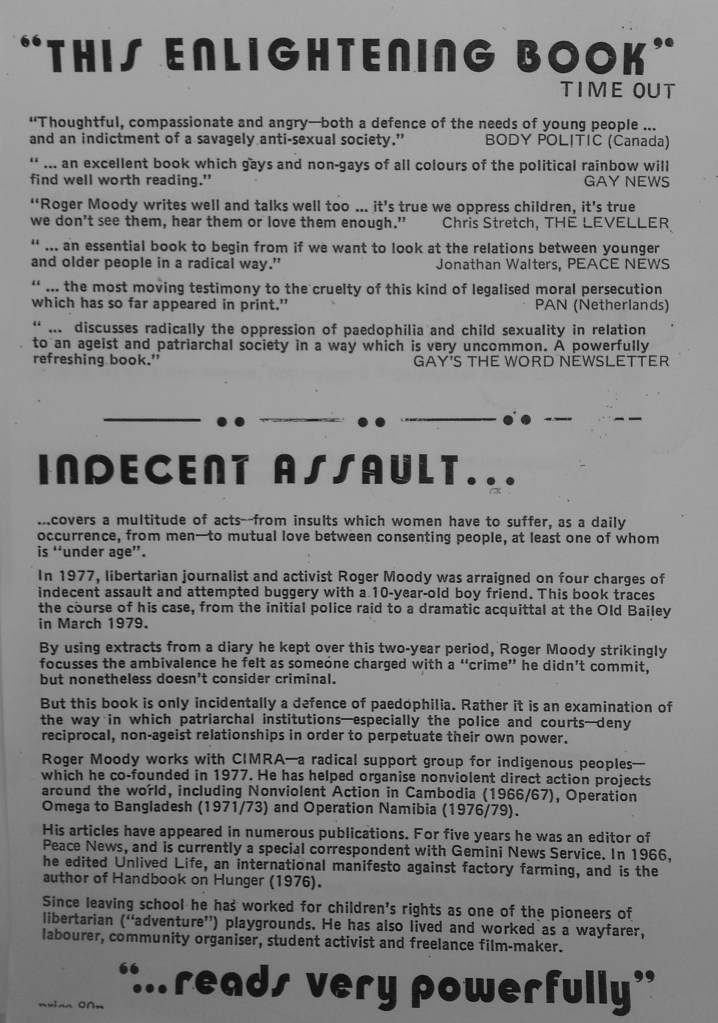
“Indecent Assault”
In 1980, Moody wrote a book called Indecent Assault, described on its jacket as “a defence of paedophilia”.
“I defend the rights of children to make mutual physical relationships with people of any age,” he wrote, describing young boys as “provocateurs”.
He even dedicated the book to “the boys”, writing: “By the time they are full grown, I trust that most of what this work describes will have become redundant ritual”.
In 1986, he wrote a chapter for another pro-paedophile book – “The Betrayal of Youth” by Warren Middleton, a former vice-chairman of the Paedophile Information Exchange.
He called his chapter: “Ends and Means: How to Make Paedophilia Acceptable”.
“The Dodger”
Despite his pro-paedophile advocacy, Moody continued finding work with kids.
In 1989, the Chelsea News and General Advertiser reported that he had just quit his job as a “youth worker” with the North Kensington Amenity Trust.
Now known as the Westway Trust, it was set up in partnership with the Royal Borough of Kensington and Chelsea.
“All employment matters would have been handled by the charity, not the local authority,” said Westway.
Roger Moody wrote to the Islington Gazette in 1991, saying he had recently been working in schools (Image: Newsquest)
A 1991 letter from Moody to the Islington Gazette, bemoaning “falling standards” in schools, revealed another job with children.
“As a youth worker who until recently worked in a school-based youth project, I was very disturbed to read your report,” he wrote, giving his address as Liverpool Road.
It was at around this time that the Met Police officer interviewed by the Gazette recalled Moody also volunteering in an Islington play park.
Islington Council said it had found no records of Moody being a past employee.
Moody’s death last year provoked tributes from academics and human rights campaigners, seemingly unaware of his murky past.
Among those who wrote eulogies was Thomas O’Carroll, former chairman of Paedophile Information Exchange.
He titled his: “Rodger the Dodger, who beat the rap”.
Aaron ( not his real name) was a child in Highbury Crescent who was abused by Moody and he gave his account to Charles Thomson journalist at the Islington Gazette in 2023.
Met Police officer on abuse at Islington children’s home. 09.03.23 Islngton Gazette
Exclusive by Charles Thomson : Investigations Reporter
A police officer has detailed how abuse and neglect at an Islington children’s home left him at the mercy of a paedophile.
Aaron – not his real name – returned to the former Highbury Crescent home with the Islington Gazette last week, to detail his ordeal.
The man is among many to have been abused at Islington children’s homes and is now speaking out, decades after whistleblowers drew attention to the scandal.
Now in his 40s, he has applied to Islington Council’s Support Payment Scheme, which offers £10,000 payments to victims of historic abuse in its homes.
He said he was speaking out to encourage others to come forward.
“Horrific”
Aaron was placed in Highbury Crescent several times because his mother, an alcoholic, struggled to look after him and his siblings, he said.
But at the home, he claimed: “I was subject to various levels of abuse. I was physically assaulted and dragged around.
“Quite often my mum would show up, drunk, trying to get us back. We would be dragged away, struck and thrown into a closet room and locked in from the outside. There was writing all over the walls and small holes knocked through.”
In addition to this physical abuse, said Aaron, children at Highbury Crescent were “neglected” – left unsupervised most of the time and often unfed.
“It was quite a horrific place,” he said.
“The only person that looked out for us was an Irish lady in the kitchen who used to give us a bit of cake or something.
“We would often just be left to our own devices for hours on end, to run around in the park opposite.”
That was where he and others encountered a paedophile called Roger Moody.
Aaron described the treatment of children at the Highbury Crescent home as ‘horrific’, including assaults and neglect (Image: Charles Thomson)
Groomed
“Whenever we used to play in the park opposite, he used to be there,” said Aaron.
“Perhaps he knew that was where he could find vulnerable children. He used to have a little black dog, Sadie.”
Gradually, Moody manipulated his way into Aaron’s life. At the time, Moody volunteered at an adventure playground near Pentonville Road, said Aaron, and told the kids he was a former youth worker.
He got to know Aaron’s family and began taking him on outings with other children, to parks and a swimming pool.
“He was very hands-on and playful with the children,” said Aaron. “We all got changed together and would all be thrown around the pool – hands-on, touching.”
Aaron’s mother accepted Moody’s offer to let Aaron stay at his house over weekends, to give her a break.
“My mother believed he was a trustworthy person,” said Aaron.
Aaron said it was in the park opposite the children’s home that he and other children encountered a paedophile called Roger Moody (Image: Charles Thomson)
Abuse
The house, in Liverpool Road, was filled “with lots of other local children that he knew and associated with, mainly of Asian descent.”
“The place was covered with cigar ash and dirt and dust,” Aaron recalled. “There was a piano with stuff piled on top of it. There were photocopiers in his house.”
Moody was a left-wing activist. He would take the boys to meetings and have them hand out the pamphlets he was producing at home.
Eventually, said Aaron, Moody’s true motive for befriending him became apparent.
Aaron described “unwanted sexual touching” by Moody, but did not want to go into detail.
“I won’t want to bring back the old demons,” he said. “I must have been about 11 or 12. No older than that. I was inappropriately touched on numerous occasions.”
Aaron is still plagued by “recurring nightmares”, he said, and sometimes situations he encounters during his work as a police officer trigger flashbacks.
Aaron never reported his abuse to the police, despite being an officer himself, but did report it several years ago to the Islington Survivors Network (ISN) (Image: Charles Thomson)
Speaking Out
Aaron never reported his abuse, even after joining the force.
“I know of historic cases that never go anywhere,” he said. “It was my word against his. I wasn’t willing to put myself through that.”
But in 2020, he contacted the Islington Survivors Network (ISN) and disclosed his abuse.
Two years later, Moody died.
A Glimpse of Life Then: Highbury Crescent
Poem by Islington Survivor
I remember the day the social worker
drove me away,
to a place where I had to stay.

It felt as though it was very far,
from the place I’d lived and known,
I felt rejected and abandoned and
totally alone,
as she drove me to live in Highbury
Crescent children’s home, away from my
family and home.

I felt as though my whole world had
ended.
I was 12 years old and was not
defended,
as my mother and social worker
organised and planned it,
to take me away as I was no longer
wanted.
Not knowing where I was going and
who I would meet.
As we parked outside, I froze in my
seat,
as I looked up at the children’s home
outside from the street.
I remember how fast my heart started
to beat,
as I was anxious and scared of the
unknown.

‘Here we are’. She said.
in a happy go lucky tone.
I remember the chirpiness of her
voice,
as she’d taken me away without any
choice.

I looked up to see the two old houses
together.
A somewhat beautiful architecture.
But in my mind I hated it!
I did not want to enter inside of it!

Maybe the houses once belonged to a
rich duke,
but somehow by chance it became a
children’s home by fluke.
It looked almost like a grand hotel.
There were chattering and laughter
and the sound of its door bell…
I remember the aroma of cooking and
cigarettes smell.
I also remember the dog named ‘Chad’,
and the little boy clinging to him with
eyes that were sad.

In the basement was where the
kitchen and dining rooms were
situated.
I wanted to leave the house and run far
away from it.
My first time walking into the living
room on my own was daunting.
Not knowing what for me was
awaiting.
It was nothing like I had ever felt
before.
As I walked towards the living room
door.
I felt embarrassed, alone, self
conscious and scared.
I had to walk in while they all just
stared.
I pretended I was brave and put on an
act,
of boldness I said ‘hello’ and sat.

There was a member of staff sitting
there.
She was wearing blue jeans,
and had brown curly hair.
She picked up her pack of fags and
offered me one.
That was the day the contract was
done!
As I became addicted to nicotine for
many years to come!

Upstairs were the bathrooms and
bedrooms.
Boys rooms in one house and the girls
in the other.
There were long corridors that led to
each other.

Looking out onto Highbury Fields
through the bedroom window,
I felt sad, alone and very low.
It was during the school summer
holidays I was placed in this home.
Separated from my family and all that
I’d known.

I could see families all walking smiling
together.
Children chatting, playing happily
together.
While I was separated from my
siblings and mother.
I felt deserted, worthless and
wretched.
No one to turn to as no one cared.
This was where I was brought to
spend my days,
with their rules to abide to in this
unfamiliar place.

My whole world and life had been
shattered and displaced.
Not knowing how to fit in,
to this new life within,
a children’s home with uncaring
strangers,
and a new life to begin.

Having to go and do what they say.
Against my will like a lamb to the
slaughter.
With no mother or father and no
protector.
I feel so confused
I was abused.
Was it my fault?
I should have refused!
But I was a child and trusted in them.
My life was never ever the same again.
Witness account of Highbury Crescent 1979-82
Between the years of 1979 to about 1982 I had friends who lived at 11 and 12 Highbury Crescent opposite Highbury Fields and was a frequent visitor there after school and weekends from aged 13.
My memories of Highbury Crescent are as follows, those of you who survived living there will have your own but here are mine as an outsider, a rare thing there, who to a certain extent witnessed some of what was going on there. I was, however, excluded from day trips and other activities instead waving everyone off from the doorstep as they were taken away in the mini bus, to where I never knew and never dared asked.
I remember the home as being a place of survival and little comfort. The management seemed to have drafted their own set of rules where violence and miss-trust pervaded; it felt sparse and clinical – a municipal expressionless dwelling, or place of hostage, under the out of control staff who ran the place according to their own hierarchy. A kind of Wild West.
There was no structure or creative activities; no art, no personal expression like posters or something that I could see. There was no food lying around in the kitchen, no biscuits, nothing homely about the place. I imagined everything was regulated and rationed.
The rules for us was whatever was going on don’t get caught. The style of management was confrontational where a situation could explode at any moment, often ending up with staff dragging off a resident to the office which was by the front door. I then had to step outside so would be on the doorstep where you could hear all the banging around and shouting and screaming going on inside behind the door.
Once they never made it in time to chuck me out, the staff room door was fully open and I saw a child being held to the ground and beaten by a member of staff. The fear and rage in the air was almost a physical thing you could touch as it was so strong around the place a lot of the time that I was visiting there. Although I was not a resident, my face was known to the staff who let their guard down when I was around.
Once I had a fight inside number 11 and was barred from there although was told I was still welcome next door at number 12. I found that really strange at the time as this would mean the resident I had the confrontation with and me would immediately be in the same common room potentially.
I thought they liked the agro. They were brutal in their response to it.
As it was, me and my opponent had had enough for one day and settled for a game of pool instead. That was just what it was like there.
There were no boundaries – a hostile environment that at any given moment could erupt with staff putting the place in a kind of lockdown – dragging a resident off to the office. One worker used to go about jangling his keys like a jailor, quite intimidating at the time.
There were no normal structures or boundaries – management running a mock, breaking the threshold of residents both physically and mentally. They took advantage of peer group pressure and confrontations allowing conflicts to escalate.
There was no overseeing of peoples’ free time either. We used to dodge out to the park opposite to sniff glue and never did any staff come over to check anything out. The boys would often disappear to the top end of the park where they would be cruised by punters offering a couple of quid for this or that – we never asked and the boys never said but we all knew. It was well known what went on up that end of the park but as girls we stayed away.
Once we staged an escape and me and two friends who were resident threw suitcases out of the windows and fled to Margate on a train with very little except a bus fares worth of loose change that we ended up spending on a portion of chips and staying out all night underneath a bus shelter. Funds exhausted and us exhausted too we bunked our way back to London and the slow retreat back into the ranks of the Crescent. The disappointment of our unsuccessful bid to be free was terrible and I remember saying bye to my two friends at Highbury knowing the frustration of admitting defeat and what they might face once they got back there.
A close friend was shipped out from the Crescent to a home in a different borough where she suffered terrible abuse and neglect. Islington was part of her chain of suffering.
The neglect, abuse and cynical dis-respect of the children in the care of Islington social services at the time was diabolical. There were politicians who were aware of accusations and allegations within Islington who chose not to investigate, perhaps for political reasons and in so doing sacrificed further generations to the appalling treatment and abuse being dished out to them in the name of child welfare.
I witnessed a friend coming out of care, too old for the home, being offered a half-way house room in 18 Highbury Grove where when we went to take a look we couldn’t understand why the curtains, lamp shade, double-bedspread were all red. It didn’t take long for her to find out. It was here she was also first introduces to taking drugs intravenously.
The world of Islington for some was a matter of survival where the only real escape on offer was to sink yourself into ever more effective levels of drug use of whatever kind. Yet another cruel legacy for some for sure.
The time for Islington to remain secretive and reclusive about this issue is over. There must now be transparency in all that they do concerning this. They must pay recompense and make reparation for what they allowed to happen, although nothing and no amount of money will ever make up for the damage inflicted upon the survivors of Islington’s Children’s Homes.
P.S. it is interesting to note that the only reference now to 11 and 12 Highbury Crescent is the following Grade II listed building status, there is no reference to its former use as a Children’s home, nothing to bear witness now but its bricks and mortar and the ghosts that lay there in
A witness who came forward to ISN in 2024



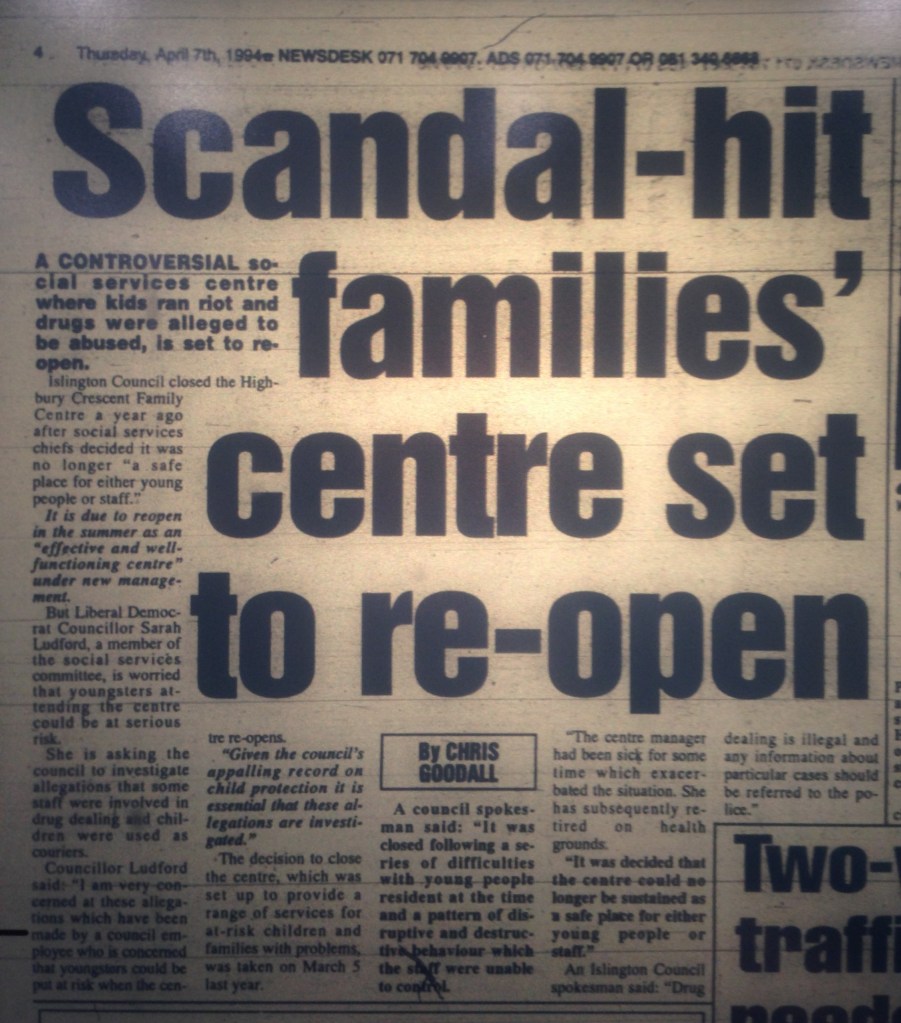
Councillor Ludford asks for investigation of allegations of staff involvement in drug dealing in Highbury Crescent. She is concerned about ‘ serious risk’.
House rules 1996: Islington Adolescent Residential Centre formerly Highbury Crescent.


The above ISN document was dated in 1996 and was signed by the social worker, residential worker and the young person

