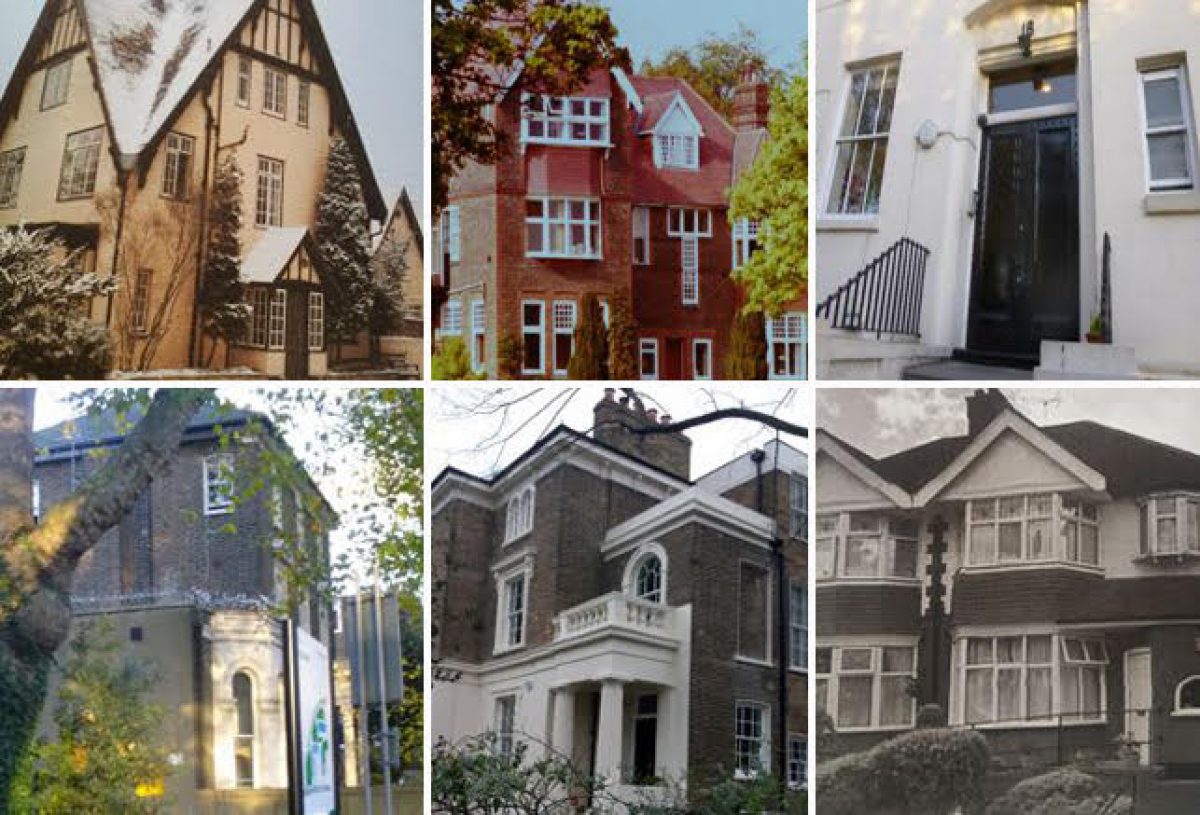
Address: 80 Highbury New Park, London N5 2DJ
Open: 1970-1992

‘At 80 security was non-existent and life was a nightmare of physical and sexual abuse.’ Young person living at 80 Highbury New Park interviewed by the Evening Standard (1992).
In 1978 it is on file in a social work record that there was only one member of staff on duty at a time in this home which meant they were unable to care for the children adequately.


Number of ISN survivors that lived at 80 Highbury New Park children’s home: 17: 11 women and 6 men – as children in 80 Highbury New Park they were aged mainly 12-16 years
Numbers of children named by ISN survivors as living in 80 Highbury New Park children’s home:: 35: 12 boys and 23 girls
Numbers of children living at 80 Highbury New Park children’s home in council documents: Not known although the Evening Standard interview of a girl who lived there in 2003 stated there were 10 children age over 15 years (01.07.2003) . In 1981, a file record stated that 80 was a residential unit for children of both sexes age 15-17. One survivor’s file (1983) states that this home only took children above the age of 15 years and worked with them towards independence. Mike Betts Inspection report of 1992 states the accommodation was for 12 young people but only 7 were resident at that time.
Residential staff named by ISN survivors as working in 80 Highbury New Park: 22: 12 women and 10 men
Life at 80 Highbury New Park children’s home
The Evening Standard coverage of the child abuse scandal from 1992 onwards described 80 Highbury New Park as a centre of child sexual exploitation with a number of older men entering the building through windows. One of the staff was said to have been listed in the White Inquiry appendix (1995) as not suitable to work with children and he left the authority in 1991 following allegations.

‘I was pregnant and a boy tried to get into my room. I had to put the bed against the door.’
‘We were left to our own devices.’
‘We only had keys to our own rooms not to the outside door.’
‘He was very off and angry with me for being on strike and not telling him.’ Social work record 1979
‘She had to be held for over an hour as she was out of control.’
‘I reported sexual abuse by male member of staff.’
‘ A man cuddled me in my room – it wasn’t right.’
The inspection report by Mike Betts, 1992
‘The documents that landed on the desk of senior Islington social services officials made grim reading. Their inspector, Mike Betts, was damning in his reports on the state of the council’s children’s homes and was demanding urgent action to protect the welfare of the youngsters who lived in them….He had already completed his inspection of the physical condition of the home and was horrified by what he saw. The building was dilapidated, dirty and insecure. Children slept on mattresses on the floor, scavenged for furniture from rubbish skips and had to share only two chairs when they sat down to eat. Sheets were used as curtains’ .’He was worried that many were expected to feed themselves on a paltry budget, leading to fears of undernourishment. He was concerned about insufficient staff, high staff turnover leading to over use of agency workers and a lack of effective security. He had already demanded that money be spent immediately on buying the children beds, curtains and a table and chair for meals’…. ‘Officers were now faced with proof from one of their own experienced staff that the state of the homes was a matter of genuine concern. The evidence amounted to a massive embarrassment for the council’. (Payne S and Fairweather E (1993) Islington the Missing Evidence. The Evening Standard 19.02.93).
Mike Betts was a senior social worker based in Essex Road Area Office [1995-97 Shepperton Road N1] and Neighbourhood Officer Social Services (NOSS) from 1984-92 in St Peter’s Neighbourhood Office [38 Devonia Road N1 8UY]. Survivors have told ISN that, as their social worker or social work manager, Mike Betts listened to them and helped them. There is no doubt that he worked against the odds as a children’s manager speaking the language of children’s rights that senior managers did not comprehend.
Mike Betts was Islington Registration and Inspections Officer in 1992. He was employed in this role for 3 months, later extended to 6 months in anticipation of the Evening Standard going to press, but Betts’ work was paused in November 92 due to industrial action. By then he had completed one report and progressed 2 others. ISN submitted a Freedom of Information Request to Islington Council (FOIA 3424822 4.10.23) requesting a copy of the Betts report but this was refused as the council said the report was no longer held by Children’s Services and that to examine committee meeting minutes would be beyond the remit of a Freedom of Information request. It is disgraceful that over 30 years later, the council refuses to enable public scrutiny of relevant documentation.
Only in 2025, did ISN obtain copies of these important documents from other sources. Three detailed and comprehensive inspection reports covered Grosvenor Avenue, Colgrain and 80 Highbury New Park children’s homes in 1992 and cited the required legal standards. The reports certainly presented a picture of the appalling physical state of the buildings as was reported in news coverage, but Betts sensitively examined every aspect of these homes from a child’s perspective considering their psychological as well as physical needs.
He described the unit as providing accommodation for up to 12 young people in single and shared rooms with one and two bedrooms. 7 young people lived there at the time of the Inspection. He wrote that, ‘many of the bedrooms are not habitable being without a proper bed or furniture and some furniture donated by young people’s friends or the staff themselves or acquired by the young people from the skips and streets of Islington’. He was critical of a lack of staff supervision when children decorated their own rooms and said that the children should be assisted and ‘not left to be surrounded by chaos‘.
He raised security issues which needed to be ‘urgently addressed‘. The bedroom windows needed security bolts and bathroom and toilets needed security grids to be fitted. ‘The young people have right to feel safe. They do not at the moment, as is seen by two of the young people who have fitted security alarms to their bedroom doors‘. He suggested the accommodation was suited to only 10 not 12 children. The unit was , he said in, ‘such a poor physical state that I would normally recommend closure’. However the young people wanted to stay there whilst work was carried out to improve the conditions. The report was detailed, pointing out the lack of sufficient crockery, cutlery, ironing board and pans in the kitchen, a toilet which did not flush and a bathroom with no shower fitting. Floor coverings, curtains and mattresses needed replacement, lights needed fitting, radiators needed thermostats and rooms needed redecoration.
On 26th August 1992, Betts wrote to social workers regarding an inspection of the children’s home.
Re: Inspection of Children’s Units
I have been appointed as the Registration and Inspection Officer to meet the Department’s new responsibilities under the Children Act. Whilst leading on registering and inspecting private sector children’s homes the majority of my work will involve working closely with staff to improve the quality of residential provision for children within our own homes. As part of this process I am consulting social workers who have a child/ young person placed at each unit, those who have parental responsibility and the child/ young person themselves. I would be grateful therefore if you could complete the enclosed form or contact me on the number provided. Your comments will help develop a profile of the unit and the services it provides and will become part of the inspection process.
Yours Sincerely
Mike Betts Registration and Inspections officer (ISN social work record)
The Betts’ reports only came to light in February 1993, following Tunnard and McAndrew’s publication of their interim report when the Evening Standard received a copy outlining 3 partially completed reports on 3 children’s homes (Tunnard and McAndrew 1993). The focus of the reports included the physical state of the properties, which had been reported consistently in monthly inspections submitted to the Case Review Sub Committee. The Morgan QC, Review related to Sandy Marks (Chair of the Committee), had noted the Committee as having been unresponsive to these very serious allegations (Morgan S QC (2018) Review Report. Chapter 15). Yet, only weeks before, the Evening Standard had published the results of a 3 month investigation into child care in the Borough and had condemned the very same homes that Betts was now criticising. Margaret Hodge had dismissed the Standard’s stories as ‘gutter journalism’ but the Health secretary Virginia Bottomley had expressed concern about the disclosures and her Inspectorate ordered the council to investigate the allegations. ( https://islingtonsurvivors.co.uk/report-16-islington-chronology-october-1992-june-1995 )
‘Sarah Ludford a Liberal- democrat councillor on the social services committee confirmed Mike Betts Reports have still not been studied. The committee’s chairwoman Sandy Marks told her this week than none even existed. The Evening Standard knows this is not true. Last week we discovered the existence of these reports and astonishingly that Islington had withheld them from the inquiry into its homes ordered by the Home Secretary. When we alerted the Inquiry, Betts was called in to give evidence. .. The Standard discovered that Betts’ reports had not been shown to the councillors or to the Tunnard and McAndrew inquiry even though Islington had pledged to provide it with all relevant documentation’ (Payne S and Fairweather E (1993) Islington the Missing Evidence. The Evening Standard 19.02.93).
‘A surveyor could do that report’. Derogatory comment on the Betts reports by Martin Higgins Director of Neighbourhood Services and Housing.
Tunnard and McAndrew in their report (Tunnard J and McAndrew B (1993) Interim Report for the Chief Executive of Islington Council. 03.02.93. Page 47) expressed concern that it was late in the review when they discovered that reports written the previous Autumn had not been included in their briefing documents. They had neither seen them nor knew they existed. Martin Higgins Director of Neighbourhood Services suggested the reason for council non-disclosure was that the Tunnard/McAndrew inquiry was not meant to be looking into the physical condition of the buildings but into the welfare of the children and whether the homes were out of control and that Bett’s reports were incomplete at the time of the industrial action. Yet, surely it was obvious that the welfare of the children was severely impacted by the appalling physical conditions and neglect in the homes. Cassam /McAndrew Report ( March 1994) repeated this dissatisfaction and said it ‘would have been prudent for the Director of Neighbourhood Services to have alerted the enquiry to the existence of the documents..’ Now that ISN have seen the reports, it is evident that all aspects of the home were indeed inspected and children’s concerns and anxieties were well recorded and that the reason for council non-disclosure was a serious misrepresentation of these 3 child centred reports.
What is evident from the Morgan Review (2018) is that Sandy Marks, as chair of the Case Review Sub Committee between 1982-94, had received many reports about the issues later raised by Mike Betts. These should have been made available to the Tunnard/McAndrew Inquiry and the other 90s investigations. Instead the report was hidden and the author punished.
An Islington Press release (18.5.93) stated that £250,000 had been spent on repairs and decoration to children’s homes. Something had been achieved for the children despite the council vilification of Betts. The young people who spoke to the Evening Standard, said that, after the exposure of the reports, a broken lavatory window regularly used by intruders was replaced and new locks and grills were fitted. They told the Evening Standard that they had not told Tunnard and McAndrew very much because they feared the home would be closed and that they would be put into Bed and Breakfast. But the children told the journalists that many issues remained outstanding.
‘They urged us to see inside their home. It bore more relation to a Dickensian workhouse and its filth and dilapidation could not be explained away by customary excuses of lack of government funding. Four months after the inspector had demanded immediate improvements there were still mattresses on the floor, curtains missing from windows, and no seat on a lavatory. Plaster was crumbling, wallpaper peeling and carpets were stained and worn. What little furniture there was broken and decrepit. There was little evidence the money Betts that had been promised had been spent. Some repairs had been started but progress was dreadfully slow.
The children said that there was little or no discipline. As well as the poor security which had meant intruders were often found inside, visitors, many much older than the residents, would stay in defiance of regulations. One, they insist, introduced them to drugs, including ecstasy, crack and cocaine, which they take at the home. The children have a meagre £20 a week food allowance and have to cook for themselves. Often they would live on toast because bread was the only food provided for them’.
When Betts returned to work in March 1993 he was told he was no longer required and he was demoted from Neighbourhood Officer to Senior Social Worker. There was no disciplinary process but he was told in an interview with Tony Cousins, Assistant Director, that he was not allowed to work with children again. He then worked with adults but tragically never recovered his position as a senior manager in children’s services – the work he really was dedicated to. The trade union NALGO, told the Evening Standard, that Betts had been ‘victimised because his reports supported the serious allegations raised in the Evening Standard’ (Fairweather E (1993) Child home inspector is demoted. Evening Standard 11.03.93).
Abusers Linked to 80 Highbury New Park
Press Coverage
‘Pimp preyed on me while I was in care’, Evening Standard 01.07.2003
‘Now we have discovered that a worried residential social worker, with the help of police, made one last desperate attempt to rescue Louise from a life of degradation and exploitation.
They snatched her from a pimp’s house and took her to safety – only for Islington social services bosses to order she be sent back to the home where the pimps had found her.’
‘How Louise, aged 15, was sent back to a life of shame’ Evening Standard, 16th October 1992
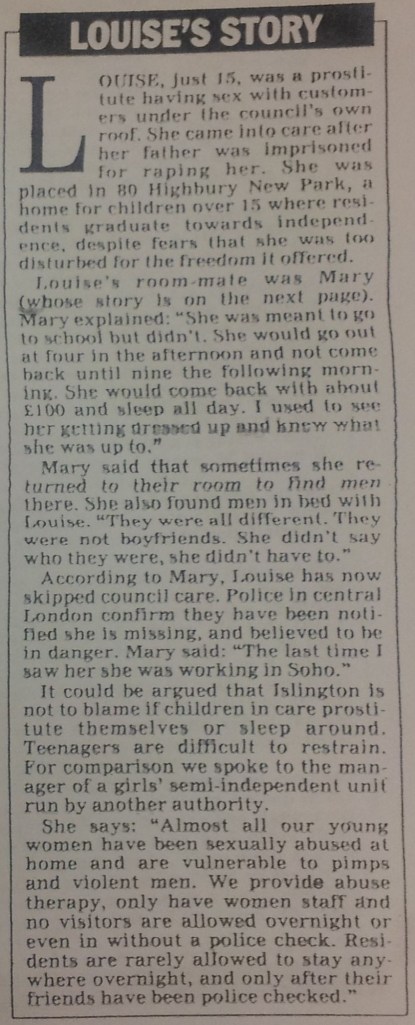
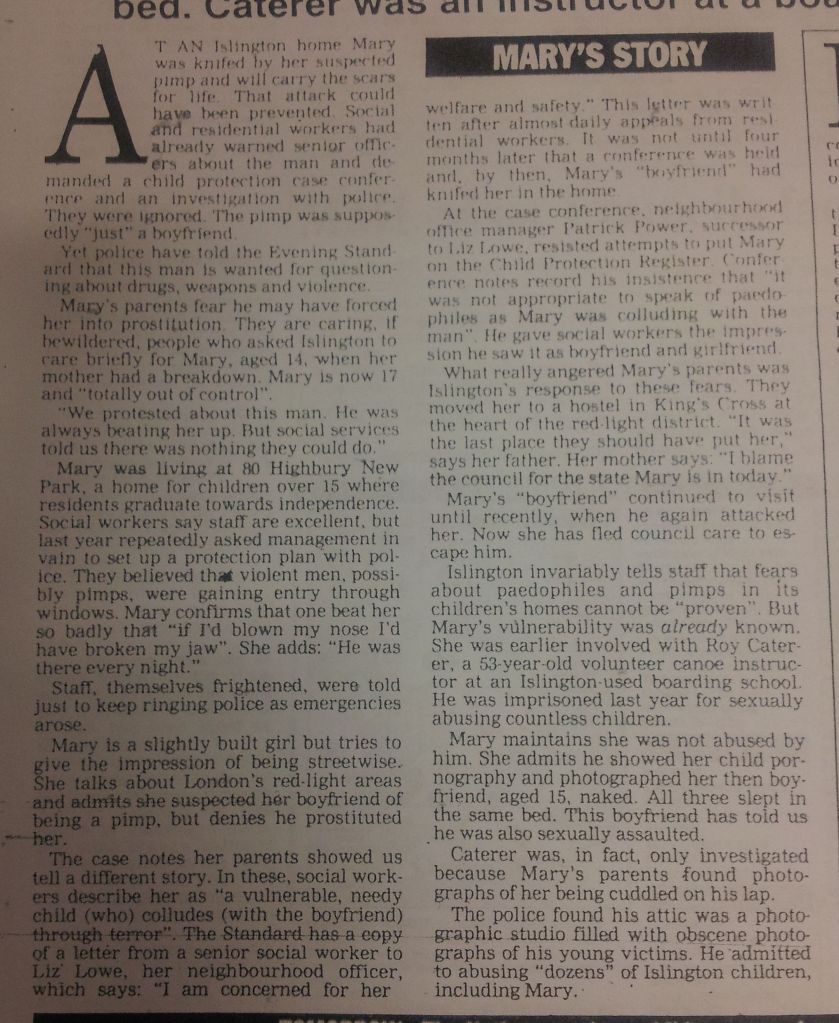
Extract from ‘The scandal at the heart of child care’ Evening Standard 06.10.1992
Andrew Davis
Andrew Davis was the subject of much press coverage when he disclosed that he thought sex with children under 8 years was acceptable. He was a member of staff in a number of Islington homes including 80 Highbury New Park but also Conewood St and Highbury Grove. One survivor’s records include a description of Davis ‘restraining’ her – which was actually PinDown.’ She was placed in a chair and held down’. ‘In our attempts to restrain her she fought back frantically and seemed to lose all control of herself’. Although ISN know PinDown was very common in all the homes it is shocking that those responsible were so blatant and confident about this practice in their recording of this abuse & torture. The child’s opinion of what happened is nowhere and there was no evidence of any managerial oversight or investigation. ISN have many accounts of PinDown and witnesses to it even to very young and disabled children.
 Islington Survivors Network