Intelligence ‘pours in’ on Islington Council child abusers

EXCLUSIVE

HISTORICAL CHILD ABUSE

Islington Gazette: 25th February 2023

Exclusive by Charles Thomson: Investigations Reporter

Intelligence ‘pours in’ on Islington Council child abusers

Islington Council has paid out almost £1 million in the past ten months to victims of historic abuse in its children’s homes. 

More than 180 complainants have come forward since last May, yielding a wealth of new intelligence about paedophiles who infiltrated the borough’s care system.

The support scheme was launched last year, more than three decades after whistleblowers first reported that Islington’s care system had been “infiltrated by paedophiles”.

“They are pouring it out,” said Dr Liz Davies, who has worked on many of the applications. 

“They’ve been naming abusers. Serious assaults. Sexual assaults. Physical assaults. Crimes.” 

In some cases, Dr Davies said, multiple complainants have named the same alleged abusers. 

READ MORE:

“I’ve done a collation of all the children’s homes,” she explained. 

“So if the police contact me and say somebody’s come forward making allegations about Mr So-and-so, I can say, ‘Ten other people have named him’.  

“Then I can contact all those survivors and say, ‘This officer in this police station is investigating Mr So-and-so’, to see if they would like to speak to them.” 

Survivors 

Dr Davies, an emeritus professor of social work at the London Metropolitan University, first raised the alarm about widespread abuse in the homes in 1990, whilst working as a social worker. 

No large-scale police investigation has ever been mounted. 

The Met Police would not comment for this article as to why.

Dr Davies now co-ordinates the Islington Survivors Network (ISN), a non-profit launched in 2016 to help victims access support, and “collate and publish the history of the Islington child abuse scandal”. 

ISN also aims to help the authorities bring abusers to justice. 

Since launching, it has been contacted by more than 600 complainants, as well as ex-staff offering witness testimony. 

In 2017, the council finally admitted and apologised for the abuse. In 2021, it announced the Islington Support Payment Scheme. 

Support Payments 

The scheme, which opened in May 2022 and closes in May 2024, offers £10,000 payments to anyone abused in any of 42 children’s homes between 1966 and 1995. 

“Abuse may be sexual, physical, emotional or neglect,” according to the 16-page form that applicants must complete. 

The scheme covers 12 homes in Islington, plus other Islington-run homes in London, Essex and Hertfordshire.  

It has received 181 applications. To date, 95 have been approved and paid out. 

“No applications have been rejected,” the council said.  

A number of successful claims will also be taken forward as individual civil suits, said Dr Davies. 

“If they win, the £10,000 will come off the damages,” she explained. 

Excluded 

Three-quarters of all applications so far have been made through ISN, which was instrumental in getting the scheme set up. 

Dr Davies said she had lost some battles, with those abused in foster care excluded from the scheme, as well as those abused in children’s homes before Islington became a London borough in 1965. 

“So there were things that were not just,” she said. 

“But in the end, because of time, we thought, we’ve got to run with what we’ve got now, to get people getting paid – because they’re dying. We’re losing them and they’re not getting the money.” 

Dr Davies said the main issue she was experiencing now was waits of “up to six months” for claimants’ care files to be disclosed, then discovering that they are missing or incomplete. 

The Rules 

“Applicants do not need their childhood care records to apply for the scheme,” the council told the Gazette

But the scheme does require “credible information and/or material” supporting a claim. 

In some cases, said Dr Davies, missing files have been overcome by ex-staff providing witness statements confirming that they remember the applicants being in the homes. 

The council confirmed that those still waiting for their care records when the scheme closes will not be excluded, as long as they have already applied for the scheme. 

“All applications submitted before the scheme ends in May 2024 will be processed,” it said. 

The Department for Work and Pensions has agreed that payments under the scheme will not be considered when calculating eligibility for benefits. 

ISN can be reached at http://www.islingtonsurvivors.co.uk: Islingtonsn@gmail.com : 0300 302 0930 They will assist survivors with applying to this Scheme.

The Met Police said anyone wishing to report non-recent abuse should do so by calling 101 or visiting http://www.met.police.uk/ro/ocr/how-to-report-a-crime/
“Your information will be passed to a specialist team who will work with you and support you,” it said. 

Met Police officer on abuse at Islington children’s home

EXCLUSIVE

Islington Gazette 9th March

Met Police officer on abuse at Islington children’s home

Exclusive by Charles Thomson : Investigations Reporter

A police officer has detailed how abuse and neglect at an Islington children’s home left him at the mercy of a paedophile.

Aaron – not his real name – returned to the former Highbury Crescent home with the Islington Gazette last week, to detail his ordeal.

The man is among many to have been abused at Islington children’s homes and is now speaking out, decades after whistleblowers drew attention to the scandal.

Now in his 40s, he has applied to Islington Council’s Support Payment Scheme, which offers £10,000 payments to victims of historic abuse in its homes.

He said he was speaking out to encourage others to come forward.

“Horrific”

Aaron was placed in Highbury Crescent several times because his mother, an alcoholic, struggled to look after him and his siblings, he said.

But at the home, he claimed: “I was subject to various levels of abuse. I was physically assaulted and dragged around.

“Quite often my mum would show up, drunk, trying to get us back. We would be dragged away, struck and thrown into a closet room and locked in from the outside. There was writing all over the walls and small holes knocked through.”

In addition to this physical abuse, said Aaron, children at Highbury Crescent were “neglected” – left unsupervised most of the time and often unfed.

CATCH-UP:

“It was quite a horrific place,” he said.

“The only person that looked out for us was an Irish lady in the kitchen who used to give us a bit of cake or something.

“We would often just be left to our own devices for hours on end, to run around in the park opposite.”

That was where he and others encountered a paedophile called Roger Moody.

Aaron described the treatment of children at the Highbury Crescent home as ‘horrific’, including assaults and neglect (Image: Charles Thomson)

Groomed

“Whenever we used to play in the park opposite, he used to be there,” said Aaron.

“Perhaps he knew that was where he could find vulnerable children. He used to have a little black dog, Sadie.”

Gradually, Moody manipulated his way into Aaron’s life. At the time, Moody volunteered at an adventure playground near Pentonville Road, said Aaron, and told the kids he was a former youth worker.

He got to know Aaron’s family and began taking him on outings with other children, to parks and a swimming pool.

“He was very hands-on and playful with the children,” said Aaron. “We all got changed together and would all be thrown around the pool – hands-on, touching.”

Aaron’s mother accepted Moody’s offer to let Aaron stay at his house over weekends, to give her a break.

“My mother believed he was a trustworthy person,” said Aaron.

Aaron said it was in the park opposite the children’s home that he and other children encountered a paedophile called Roger Moody (Image: Charles Thomson)

Abuse

The house, in Liverpool Road, was filled “with lots of other local children that he knew and associated with, mainly of Asian descent.”

“The place was covered with cigar ash and dirt and dust,” Aaron recalled. “There was a piano with stuff piled on top of it. There were photocopiers in his house.”

Moody was a left-wing activist. He would take the boys to meetings and have them hand out the pamphlets he was producing at home.

Eventually, said Aaron, Moody’s true motive for befriending him became apparent.

Aaron described “unwanted sexual touching” by Moody, but did not want to go into detail.

“I won’t want to bring back the old demons,” he said. “I must have been about 11 or 12. No older than that. I was inappropriately touched on numerous occasions.”

Aaron is still plagued by “recurring nightmares”, he said, and sometimes situations he encounters during his work as a police officer trigger flashbacks.

Aaron never reported his abuse to the police, despite being an officer himself, but did report it several years ago to the Islington Survivors Network (ISN) (Image: Charles Thomson)

Speaking Out

Aaron never reported his abuse, even after joining the force.

“I know of historic cases that never go anywhere,” he said. “It was my word against his. I wasn’t willing to put myself through that.”

But in 2020, he contacted the Islington Survivors Network (ISN) and disclosed his abuse.

Two years later, Moody died.

Islington Council said: “We’re deeply sorry for the council’s past failure to protect vulnerable children in its children’s homes, which was the worst chapter in this council’s history.”

Since May 2022, the authority has paid more than £1 million in support payments to victims of abuse.

Next week: The Gazette investigates Roger Moody, the teflon paedophile who kept finding ways to work with children.

ISN can be reached on 0300 302 0930 or by emailing islingtonsn@gmail.com.

Roger Moody

North London: Youth worker Roger Moody was a proud paedophile

Islington Gazette 28th March 2023

By Charles Thomson Investigations Reporter

A proud paedophile managed to continue working with children even after authoring books, articles and pamphlets advocating sex between men and children.

Throughout the 1970s and 1980s, youth worker Roger Moody called for the age of consent to be abolished, even writing a book bemoaning “simplistic and bigoted” attitudes towards paedophiles.

But press cuttings from the late 1980s and early 1990s show he was still managing to get jobs working with children.  

Earlier this month, the Islington Gazette interviewed a Met Police officer who said he was abused by Moody in the 1990s and recalled him being a volunteer at an Islington adventure playground.

In 2020, that officer was one of two people to approach the Islington Survivors Network (ISN) and report historic abuse by Moody.

Others made allegations decades earlier, but Moody was acquitted at trial.

Moody died in 2022.

The Gazette interviewed a Met Police officer who said he encountered Roger Moody as a direct result of neglect at the former Highbury Crescent children’s home.

‘Boy lover’

Roger Moody was a left-wing activist, campaigning against human rights abuses in the developing world.

In 1971, he even wrote for the Islington Gazette from Bangladesh, where he was delivering aid.

He lived in Caledonian Road at the time and was a “youth worker” in the Bemerton Adventure Playground in Copenhagen Street, Barnsbury.

But in 1975, when Moody outed himself as a paedophile, that should surely have spelled the end of his work with children.

He outed himself in a letter to Peace News, later calling it “the first confessional article by a boy-lover to appear in the British radical press”.

In a follow-up, he claimed sex only occurred between children and paedophiles “because the kids really want it”.

Alarmingly, the address he gave in those letters – in Dartmouth Park Hill, Kentish Town – was also the exact address of a “children’s community centre”.

Trial

In 1978, Moody was charged with child sex offences.

He was acquitted in 1979 at the Old Bailey after the judge banned the jury from seeing his pro-paedophile articles.

In one, he had called on paedophiles to adopt “revolutionary” tactics against their “repression”.

“Specifically, this means we don’t work to lower the age of consent, but to abolish it,” it said.

Ten days after his acquittal, he was arrested again after being seen hand-in-hand with a ten-year-old boy.

No charges followed.

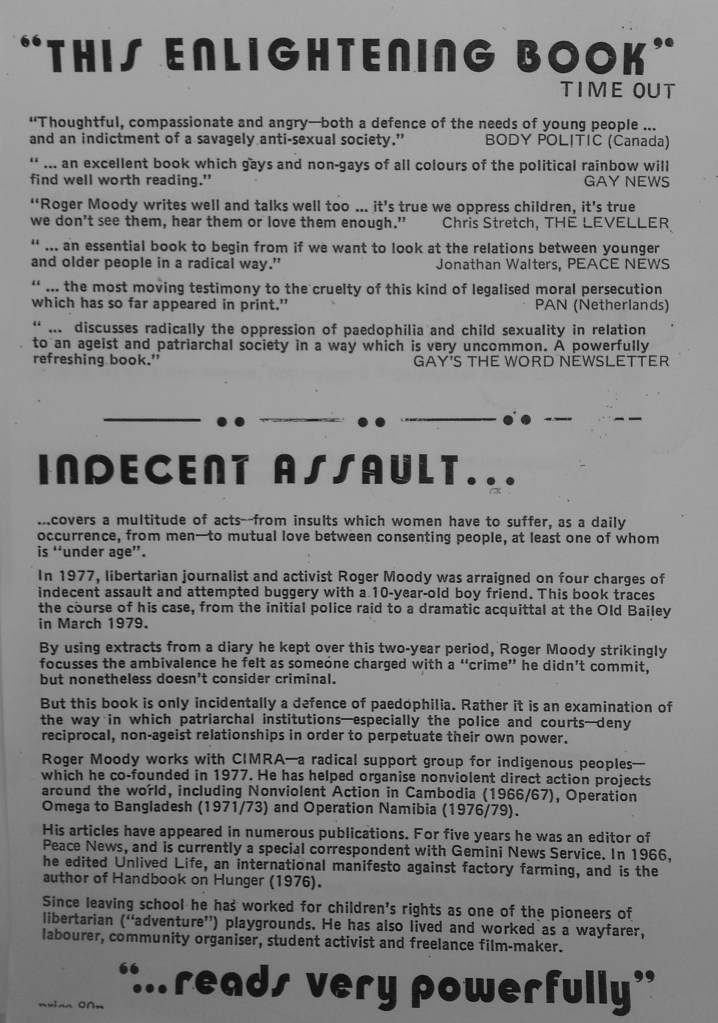
Roger Moody rote a book titled ‘Indecent Assault’, described on the jacket as ‘a defence of paedophilia’ (Image: Charles Thomson)

“Indecent Assault”

In 1980, Moody wrote a book called Indecent Assault, described on its jacket as “a defence of paedophilia”.

“I defend the rights of children to make mutual physical relationships with people of any age,” he wrote, describing young boys as “provocateurs”.

He even dedicated the book to “the boys”, writing: “By the time they are full grown, I trust that most of what this work describes will have become redundant ritual”.

In 1986, he wrote a chapter for another pro-paedophile book – “The Betrayal of Youth” by Warren Middleton, a former vice-chairman of the Paedophile Information Exchange.

He called his chapter: “Ends and Means: How to Make Paedophilia Acceptable”.

“The Dodger”

Despite his pro-paedophile advocacy, Moody continued finding work with kids.

In 1989, the Chelsea News and General Advertiser reported that he had just quit his job as a “youth worker” with the North Kensington Amenity Trust.

Now known as the Westway Trust, it was set up in partnership with the Royal Borough of Kensington and Chelsea.

“All employment matters would have been handled by the charity, not the local authority,” said Westway.

Roger Moody wrote to the Islington Gazette in 1991, saying he had recently been working in schools (Image: Newsquest)

A 1991 letter from Moody to the Islington Gazette, bemoaning “falling standards” in schools, revealed another job with children.

“As a youth worker who until recently worked in a school-based youth project, I was very disturbed to read your report,” he wrote, giving his address as Liverpool Road.

It was at around this time that the Met Police officer interviewed by the Gazette recalled Moody also volunteering in an Islington play park.

Islington Council said it had found no records of Moody being a past employee.

Moody’s death last year provoked tributes from academics and human rights campaigners, seemingly unaware of his murky past.

Among those who wrote eulogies was Thomas O’Carroll, former chairman of Paedophile Information Exchange.

He titled his: “Rodger the Dodger, who beat the rap”.

The Islington Survivors Network can be reached on 0300 302 0930 or by emailing islingtonsn@gmail.com.